
This year, anyone still harbouring doubts about climate change has had a rude awakening. Not so long ago, in England, we routinely complained about our disappointing summers and escaped south in search of sunshine. Now we complain about the heat and increasingly, I suspect, will be escaping northwards each summer.
As one heat alert follows another and temperature records continue to tumble, I have noticed something rather unexpected. My dog, normally happiest charging endlessly after a ball, is instead chasing the shadows. Without really realising it, so have I.
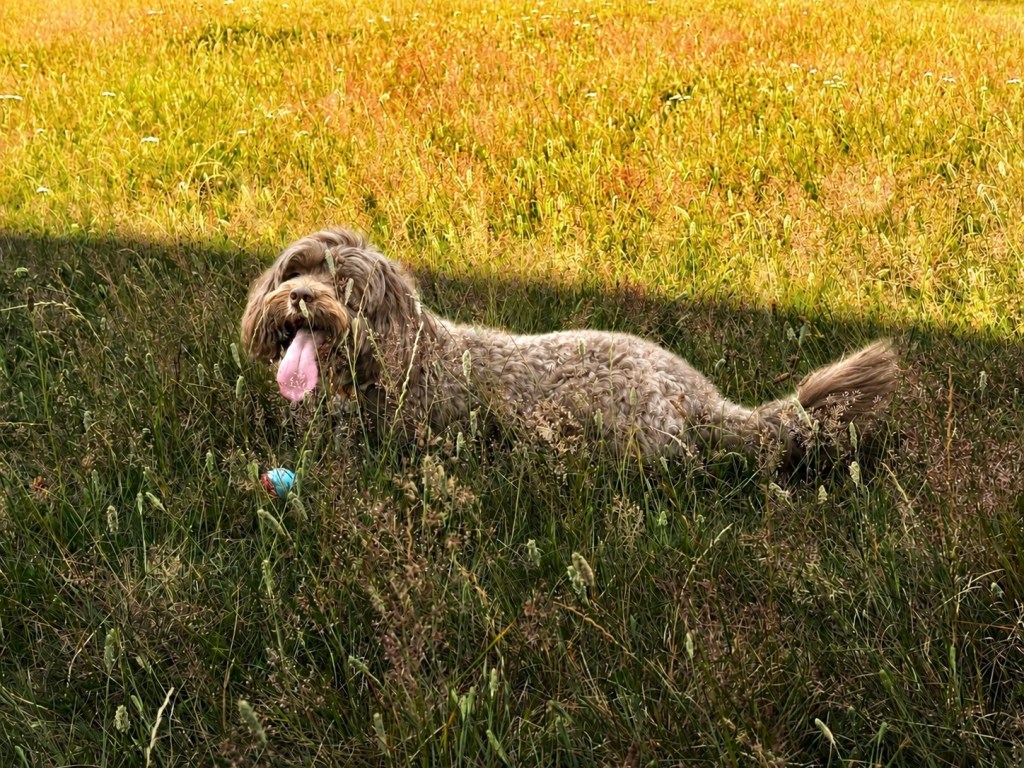
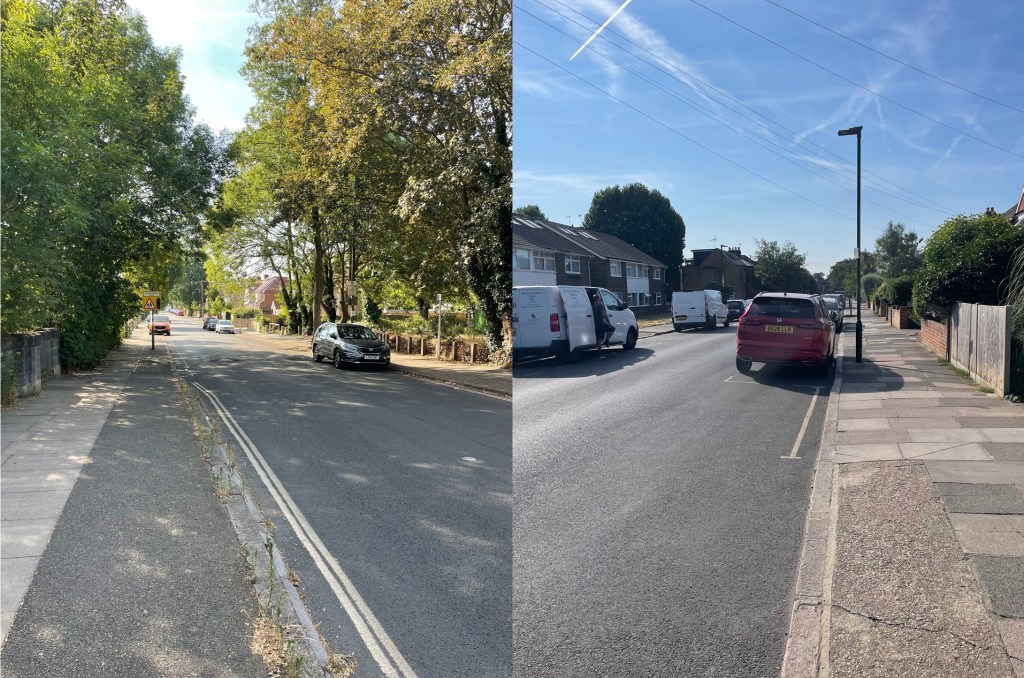
This summer my dog and I have spent a great deal of time in leafy West London while taking turns with my siblings to care for my ageing mother. There are two routes from her house to the local park. The first is shorter, following a long residential street with greenery tucked away in private front gardens but no street trees. The second takes a little longer, winding along streets lined with mature trees whose canopies cast deep shade across the pavement.
Normally the dog’s priorities dictate the route: get to the park as quickly as possible. But recently, almost without consciously deciding, we have started taking the longer route. We now choose the coolest journey rather than the quickest.
Even our routine once we reach the park has changed. We would usually follow a circular walk: out on a tree-lined path, back on a more open path that offers plenty of room for throwing the ball. Lately, we have abandoned the sunny return leg altogether, instead retracing our steps beneath the trees. Shade has become the destination.
The science explains why
Studies in the Manchester have found that the surface temperature of a shaded street can be on average 12°C cooler than an equivalent unshaded one. When measured using Mean Radiant Temperature – a better indicator of the total heat load experienced by the human body – the difference is still around 4°C. Arup’s 2023 study of London, combining satellite imagery with ground-level measurements, found that heavily built-up, unshaded streets such as those in Kilburn experienced localised temperatures up to 7°C hotter than highly vegetated places such as Regent’s Park only a short distance away.
The problem does not end when the sun goes down. Unshaded roads and pavements absorb heat throughout the day before slowly releasing it overnight, keeping neighbourhoods uncomfortably – and sometimes dangerously – warm long after sunset. Perhaps most troubling of all, evidence suggests that these conditions are typically worst in the most deprived communities.
My dog-walking observations hardly qualify as rigorous scientific research. Yet they vividly illustrate something the evidence has been telling us for years: street trees fundamentally change how we experience our towns and cities. Their cooling effect is only part of the story. They also improve mental health, support biodiversity, reduce pollution, make streets more attractive, and create places where people simply want to spend time and – all-importantly – choose to walk.
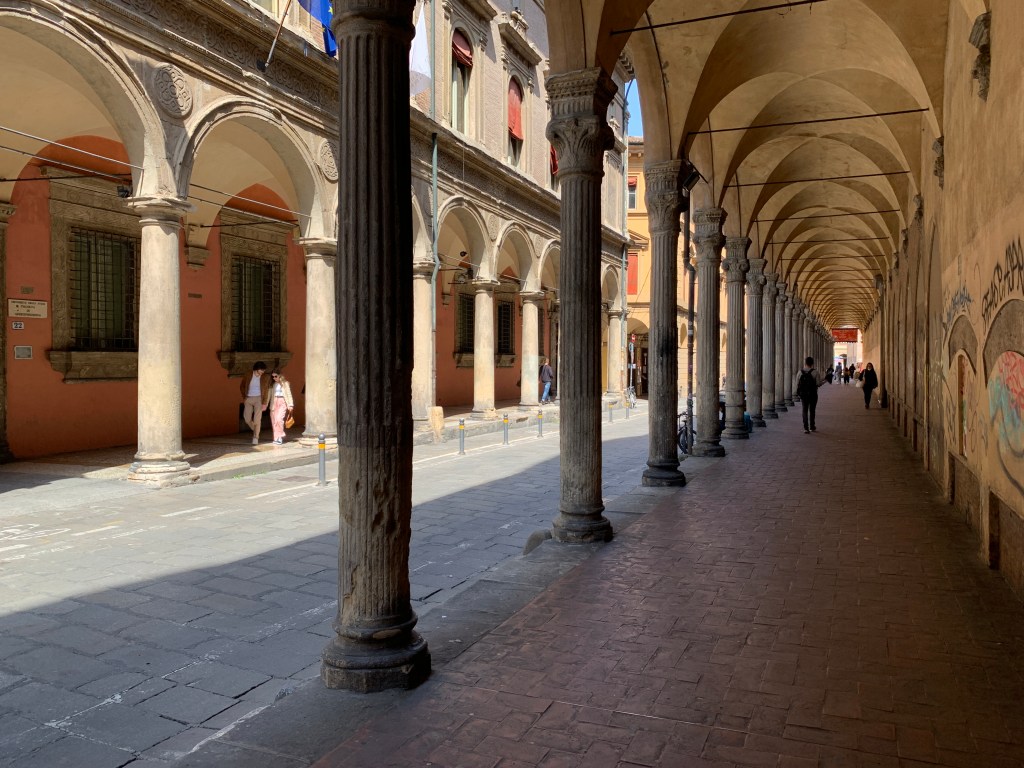
Some cities have been dealing with heat for centuries. Bologna, in northern Italy, has long endured summer temperatures well into the mid-thirties. From the eleventh century onwards, its extraordinary network of porticoes and colonnades allowed generations of Bolognese to move comfortably through the city while remaining in shade for much of the journey. Our largely suburban towns and cities do not have miles of medieval arcades, but we do have something capable of performing much the same function: trees. Their canopies shade our streets while simultaneously cooling the surrounding air through evapotranspiration, with every mature tree acting as a remarkably efficient natural air conditioner.
Given these benefits, why do we still treat street trees as a cost rather than an investment?
Part of the answer lies in the way we govern our public realm. Highway authorities are typically responsible for the costs and liabilities of planting and maintaining trees yet receive little direct benefit from the improvements they deliver to public health, wellbeing, biodiversity, climate resilience and property values. The costs fall to one organisation – who resist new trees being planted unless their long-term maintenance is paid for handsomely in advance – while the benefits are spread across society.
But creating new streets without street trees is increasingly becoming unthinkable. Indeed, this year I have been leading a new Housing Design Audit (to be published by MHCLG in the autumn), and as part of a refreshed set of assessment criteria, we have incorporated the ‘30’ from the Nature Based Solutions Institute’s 3-30-300 rule. It offers a wonderfully simple benchmark for greener neighbourhoods summed up in the graphic.
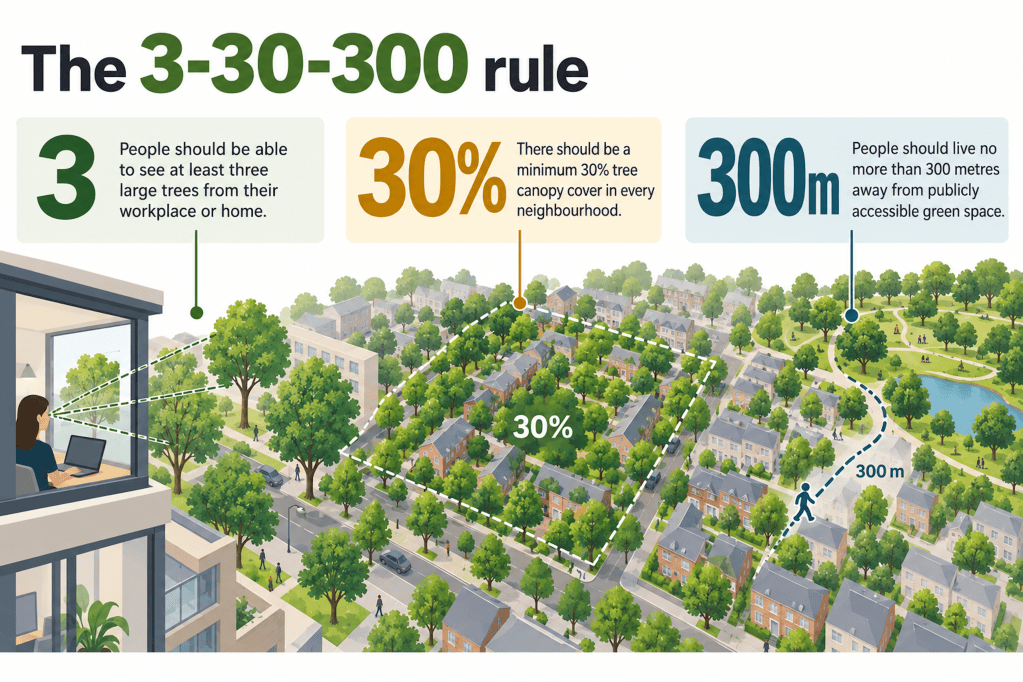
Simple rules perhaps, but powerful ones, and the new audit in effect and for the first time incorporates shade as part of its assessment of what constitutes good design (other criteria in the audit pick up on the issues encompassed by the ‘3’ and the ‘300’).
Of course, trees cannot simply be wished into existence. They take decades to mature, which means they must be planned from the very beginning of new developments. Retrofitting them later is invariably more difficult and expensive because of underground utilities, highway constraints and competing demands for space (notably from parking). And, as my own local authority in south-east London fails to understand, newly planted trees also need something rather fundamental if they are to survive: water.
So as our climate becomes both hotter and drier, we also need to think much more carefully about species selection. Which trees will thrive under future conditions? Which will grow large enough to create meaningful canopy cover? How quickly will they mature? How will they connect neighbourhoods to parks and other green spaces, creating continuous shaded routes for people (and their dogs)? How can they be protected and sustained in their early years? And who should pay for the upkeep of a resource with such widespread and shared societal benefits?
Some places already enjoy the benefits. Much of leafy West London is one such place. But in a warming climate, access to shade should not be a privilege enjoyed by the fortunate few. Street trees have always been valued by those lucky enough to live with them, but now, more than ever, we are coming to appreciate their role as vital pieces of natural urban infrastructure.
The question is no longer whether we can afford to plant and nurture street trees.
It is whether we can afford not to.
Matthew Carmona
Professor of Planning & Urban Design
The Bartlett School of Planning, UCL

