In the decades following the demise of the post-war New Towns programme, the shift towards market-led solutions to meet national housing need has made it remarkably difficult to replicate the scale and ambition of those earlier developments. Successive attempts have come in different guises: the entirely private ‘new country towns’ proposed by a consortium of developers in the mid-1980s; the ‘Millenium communities’ instigated in 1997 and ‘Eco-towns’ launched with a fanfare in 2007 by New Labour; and the ‘Garden villages’ and ‘Garden towns’ promoted by the Conservatives from 2016 onwards.
All have struggled to achieve their intended scale, ambition and pace. One worries that the current Government’s new ‘new towns’ programme could go the same way unless considerably more political drive and investment is put behind its ambition to deliver the seven new towns that are currently proposed.
Quantity takes time
The post-war New Towns are often presented as a crowning achievement of a centrally planned state, but the numbers of homes delivered were not enormous. Centre for Cities estimates that the 32 new towns delivered 307,000 new homes in England between 1947 and 1993, or just 3.3% of all homes built during that period. A key factor, however, was their ability to build at a faster rate than elsewhere in an altogether simpler context for development than we face today. At its peak, Milton Keynes – the largest and fastest-growing of the new towns – was building around 3,000 homes a year.
Against this benchmark, our more recent new settlement efforts look decidedly meagre:
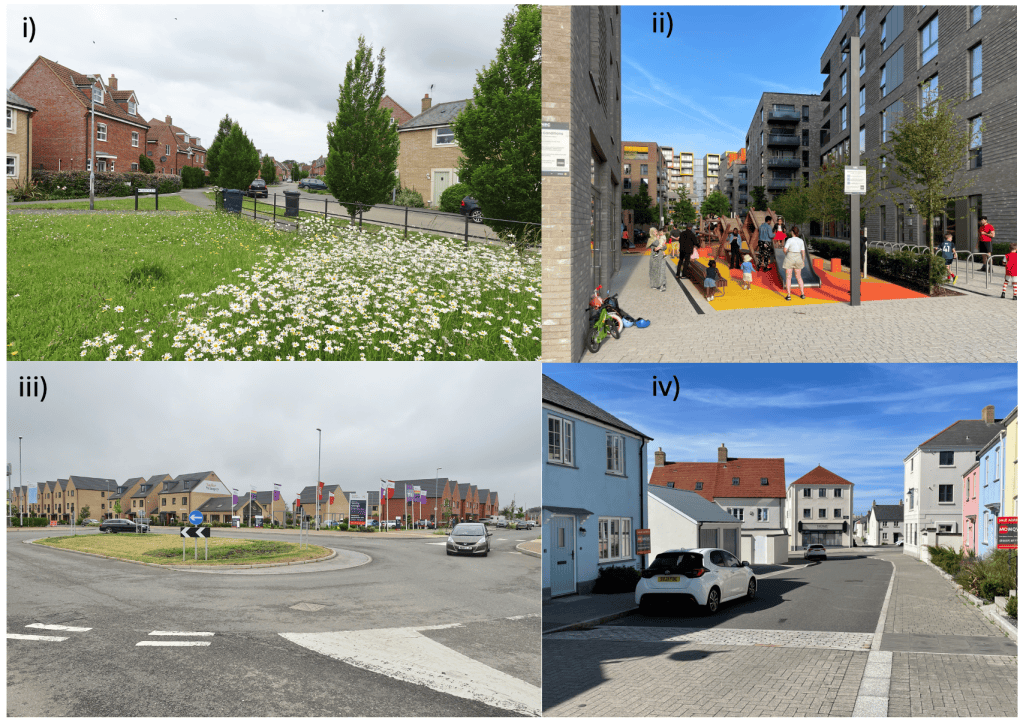
- Cranbrook, in Devon, and Cambourne, in Cambridgeshire, are among the longest-established examples, with plans emerging in the late 1980s and early 1990s. Yet Cranbrook took 20 years to get started and has so far reached around 3,300 of its projected 8,000 homes. Cambourne was quicker off the mark, taking around 10 years to begin, but has still delivered only 4,250 of its projected 20,000 homes.
- Greenwich Millenium Village struck ground in 1999 and 27 years later is still to reach its 2,800 completion target, although it is getting close with approaching 2,000 units completed on site. The other six Millenium village projects were much smaller, but only one – Allerton Bywater at 520 homes – has been completed.
- Northwest Bicester, Oxfordshire, was first mooted in 2008 and is the only designated eco-town to have progressed to development, beginning on site in 2016. So far, only around 400 of its planned 6,000 homes have been delivered, amid financial viability disputes, planning complexities and unresolved transport and highway issues. Across Bicester, Graven Hill, planned and begun around the same time, has fared a little better, with around 750 of its planned 2,100 homes complete.
- Northstowe, in Cambridgeshire, predates the eco-town initiative, with the first proposals dating from 2003, although development did not get underway until 2016. Around 1,500 of its projected 10,000 homes have now been built, but the development has attracted high-profile criticism for failing to create a genuine new place beyond the delivery of largely standard volume-housebuilder homes.
- Sherford, near Plymouth, has delivered a similar number of homes against a planned 5,500. Nansleden, in Cornwall, has delivered around 800 of 4,000. Both were planned during the 2010s and are characterised by the mock-Georgian architecture popularised at Poundbury. Poundbury itself is within 300 homes of its 2,700-home completion target, but it has taken 38 years to get there.
- Welborne Garden Village, in Hampshire, is in a similar ilk, and with the first 700-unit phase of a planned 6,000 homes on site, is ahead of most of the officially sanctioned garden settlements that received funding in 2017. Others are inching forward through myriad layers of planning, regulatory and legal complexity, including Longcross Garden Village (just beginning to deliver its planned 1,800 homes), Dunton Hills Garden Village(4,000 homes planned), Culm Garden Village (5,000), Tendring Colchester Borders Garden Community(7,750), Otterpool Park (10,000), and, largest of all, Harlow and Gilston Garden Town (23,000).
What the various garden community propositions will ultimately deliver remains to be seen, but one final example is streaks ahead: Ebbsfleet Garden City.
Quality takes time
Ebbsfleet received funding a little earlier, in 2014, as a precursor to the wider drive to create new garden communities. Its story begins deep in the chalk pits of Kent, where centuries of heavy industry and cement manufacturing left a scarred industrial landscape, while the arrival of high-speed rail at Ebbsfleet International in 2007 bridged the gap between this part of the Thames Gateway and central London, cutting journey times to the capital to under twenty minutes and creating the prospect of London commuting times for sub-London property prices.
Recognising its potential to help tackle the housing crisis, in 2015 the then Government designated Ebbsfleet Development Corporation, with the ambition of delivering the first proper Garden City since Welwyn. But the Development Corporation inherited a far from ideal starting point:
- Much of the site consisted of former quarries, with high walls and barren, polluted interiors. Initially, around £100 million was required for land remediation and local infrastructure, while the remaining land was a fragmented mixture of working and abandoned industrial sites, immediately adjacent to the equally fragmented settlements of Swanscombe, Northfleet and Greenhithe. The huge Bluewater regional shopping centre sat isolated in its own adjacent quarry, while the A2/M2 motorway formed a barrier to the south and the River Thames lay to the north.
- The Development Corporation was not a conventional master developer and landowner with all the power that imbues. Instead, it was established primarily as a planning and regeneration catalyst with responsibility for developing the entire site. It was to use planning powers, public infrastructure funding and targeted strategic acquisitions to incentivise private development, rather than shoulder the enormous cost of buying out the whole site.
- Finally, much of the land, including the easier development propositions, was already subject to outline development proposals with granted planning consents. These had been consented before the Garden City designation and were based on standards more appropriate to conventional volume housebuilding than to the creation of a new Garden City.
All of this looked deeply unpromising, and I, like many other visitors in the early years, was dismayed to see standard suburban volume-housebuilder products rolling out with little obvious attempt to create a sustainable place with a distinct character or its own gravitational pull. Walking through the early phases, it seemed much more like a dormitory suburb than an emerging Garden City.
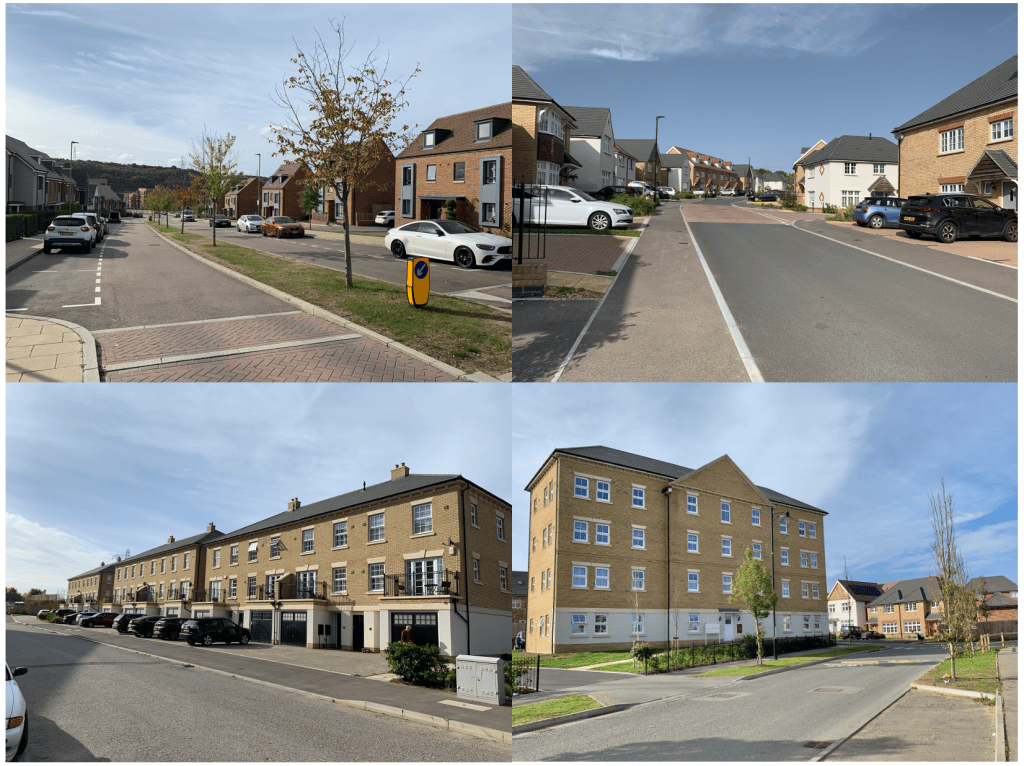
But we were judging what had come before – the permissions granted before the Garden City designation – rather than what was being planned for the future. That future is now beginning to emerge.
Quality requires determination
Rather than accepting that the earlier outline applications had fixed everything, the Development Corporation set about establishing a much larger vision into which existing and future applications could fit. This extends from the overall masterplan for the development, through a detailed Ebbsfleet Character Design Guide and Public Realm Strategy, to site-specific masterplans and design codes for each neighbourhood. These operates at different scales.
At the settlement-wide scale:
- Landscape and topography: the macro-scale design responds inventively to the dramatic post-industrial landscape, including its chalk quarries, escarpments and relationship with the Thames Estuary.
- Blue and green infrastructure: 40% of the city layout is mandated to comprise interconnected green and blue spaces, green corridors and structured park hierarchies.
- Unified narratives: a common city-wide vocabulary is established while allowing distinct areas to develop their own identities, including the Chalk Quarries, Ebbsfleet Valley, Swanscombe Marshes and Northfleet Riverside.
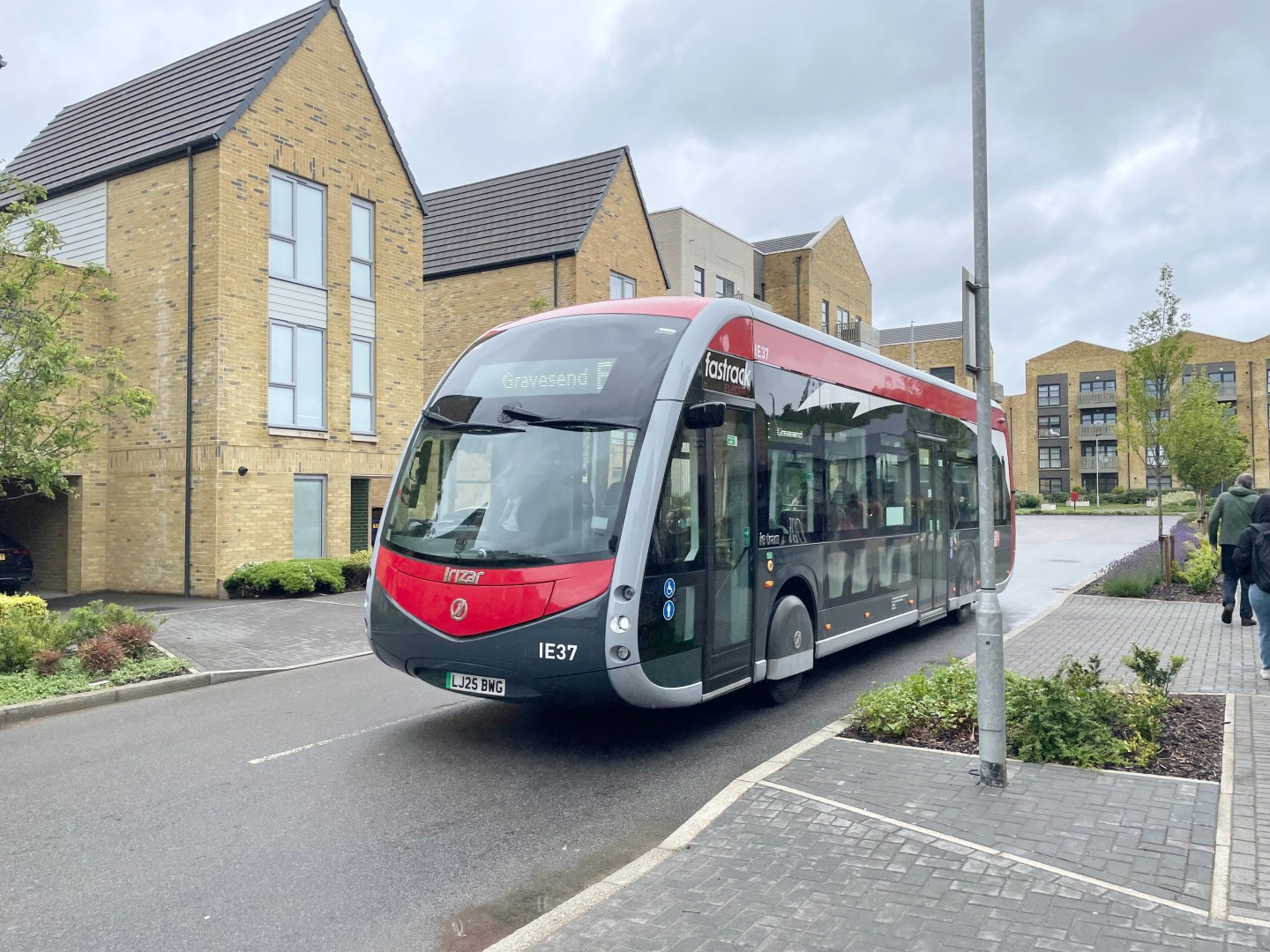
- Sustainable travel: a dedicated zero-emission Fastrack bus network runs throughout the Garden City and beyond, including (soon) a dedicated tunnel connecting directly to Bluewater.
At the neighbourhood scale:
- Design narratives for sub-areas: localised typologies guide building heights and street layouts, including The Coombe (hollows in escarpments), The Hithe/Fleet (waterfront edges) and The Defined Settlement (fine-grain urban blocks).
- Park hierarchy: green space is organised into pocket parks within residential streets, neighbourhood parks within a five-minute walk, and larger community focal parks.
- Architectural language: the scale, verticality and use of local materials – including red brick detailing, flint and chalk-inspired plinths – are directed to ensure that individual developments respond to their particular micro-topography.
- Investing in place-making: an extensive programme of activities and community engagement, alongside the NHS Healthy New Town designation, is helping to build a sense of community and place.
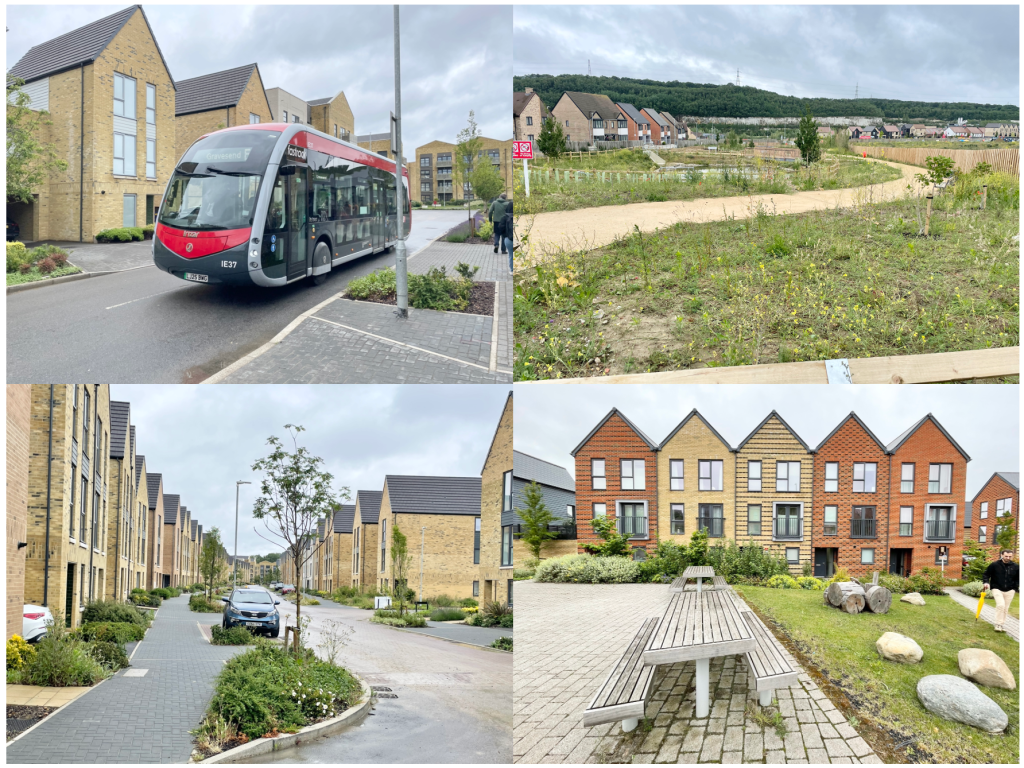
Visiting today, one can begin to see that this is more than rhetoric. The vision is emerging on the ground, a vision that the small but highly effective team at the Ebbsfleet Garden City Development Corporation has relentless pursued, despite the challenges inherited from the past and the more recent uncertainties of the market, construction-costs, and national political shenanigans.
The work is layered and complex, but it is possible to see how the sort of principles for flourishing communities discussed in a related blog are being translated into practice. This includes:
- Getting the bones right: excellent public transport, schools, parks, local amenities and connections to Bluewater are all appearing and will shape the social character and environmental performance of the place for decades to come.
- Sticking doggedly to the vision: quality is being pursued all the way through, even when that requires compromises and working creatively within a sub-optimal inherited framework.
- Worrying about the details: from how houses address streets, to how parking is integrated and managed, to how streets are greened and buildings express variety and human character. These may sound like small things, but they are what ultimately shape people’s experience of a place.
Quality and quantity (not enemies)
Ebbsfleet Garden City is far from perfect. Its inherited shortcomings continue to shape current phases of development, and whether it will ultimately become a genuinely self-sustaining town with character and community – a true Garden City – only time will tell. Later phases, will provide a clearer opportunity to demonstrate what is possible when land, planning and design ambitions are aligned from the outset. Ebbsfleet Central, around Ebbsfleet International Station, is a case-in-point where the Development Corporation has been able to acquire the land and where no pre-existing planning applications constrain the vision.
Yet even with all the constraints elsewhere, Ebbsfleet is already showing what determination and vision can achieve. It also shows that quality does not have to be the enemy of quantity.
By the numbers alone, Ebbsfleet is one of the more successful new settlements in recent decades. The Garden City is delivering around 600 homes a year (25-30% affordable) and reached the milestone of 5,000 new homes in 2026. That is nowhere near Milton Keynes at its peak, but it is impressive given the extraordinary constraints of the site, and the more limited ambition of 15,000 homes in total.
Since the 1980s, England has struggled to deliver new homes at scale. Too many proposals for new settlements have been small, slow – if they get off the ground at all – and lacking in quality. Ebbsfleet shows that we can do better. It shows that quality and quantity are not necessarily competing objectives, even on a complex, semi-urbanised, former industrial land. What matters is the combination of a strong vision, the powers and resources to pursue it, and the determination to keep pushing for quality through every layer of planning and delivery.
The challenge for the Government – and for those responsible for the next generation of new towns – is to learn these lessons and apply them simultaneously across numerous sites. But it can be done.
Matthew Carmona
Professor of Planning & Urban Design
The Bartlett School of Planning, UCL

