Britain has been here before.
From the utopian visions of the late nineteenth century to the sweeping ambitions of the post-war era, the idea of building entirely new communities has long captured the national imagination. Each generation has turned to ‘new towns’ as a solution to pressing urban challenges – overcrowding, housing shortages, and the desire for better living environments. Yet, as my recent paper in the Journal of Urban Design makes clear, the story of Britain’s new towns is not one of steady progress, but instead of ambition, experimentation, critique, disengagement and now, rediscovery.
This historical arc matters. It shows that building new towns is not just a technical exercise, it is a profoundly political, social, and institutional challenge. Today, with a government-backed programme of ‘new new towns’, Britain once again stands at a crossroads. The question I address in the paper is not about whether to build new towns (or where), but how to build them well.
A new inquiry
My analysis draws from evidence gathered for the UK House of Lords inquiry New Towns: Creating Communities, to which I was privileged to act as Specialist Advisor. The paper consequently draws on an unusually rich body of evidence – around 375,000 words of written and oral testimony from academics, developers, policy makers, community groups, and citizens.
This evidence was systematically coded and analysed to identify patterns of agreement and divergence across nine key themes. The approach allowed me to move beyond isolated opinions and distil a broad consensus about what makes new towns succeed – or fail.
Importantly, the inquiry itself built upon the foundation laid by the New Towns Taskforce which had earlier recognised that today’s ‘new towns’ will not always be standalone settlements. Many will be urban extensions, satellites, or regeneration projects embedded within existing cities. That shift alone introduces fundamental new design and governance challenges.
A clear message: it’s not about speed or scale
So what did the evidence reveal?
The conclusion is striking in its clarity: the success of new towns will not depend on how quickly they are built, how large they are, or even where they are located. Instead, it hinges on whether they are conceived as long-term, integrated systems – social, environmental, and economic – not just as housing delivery mechanisms.
This is a fundamental reframing. Too often, recent development in the UK has been characterised by fragmented governance, car-dependent layouts, and infrastructure that lags behind the housing. The result has been places that struggle to foster community, health, or resilience.
The new programme offers a chance to reset that model, but only if it learns from past mistakes.
Nine Principles for Flourishing Communities
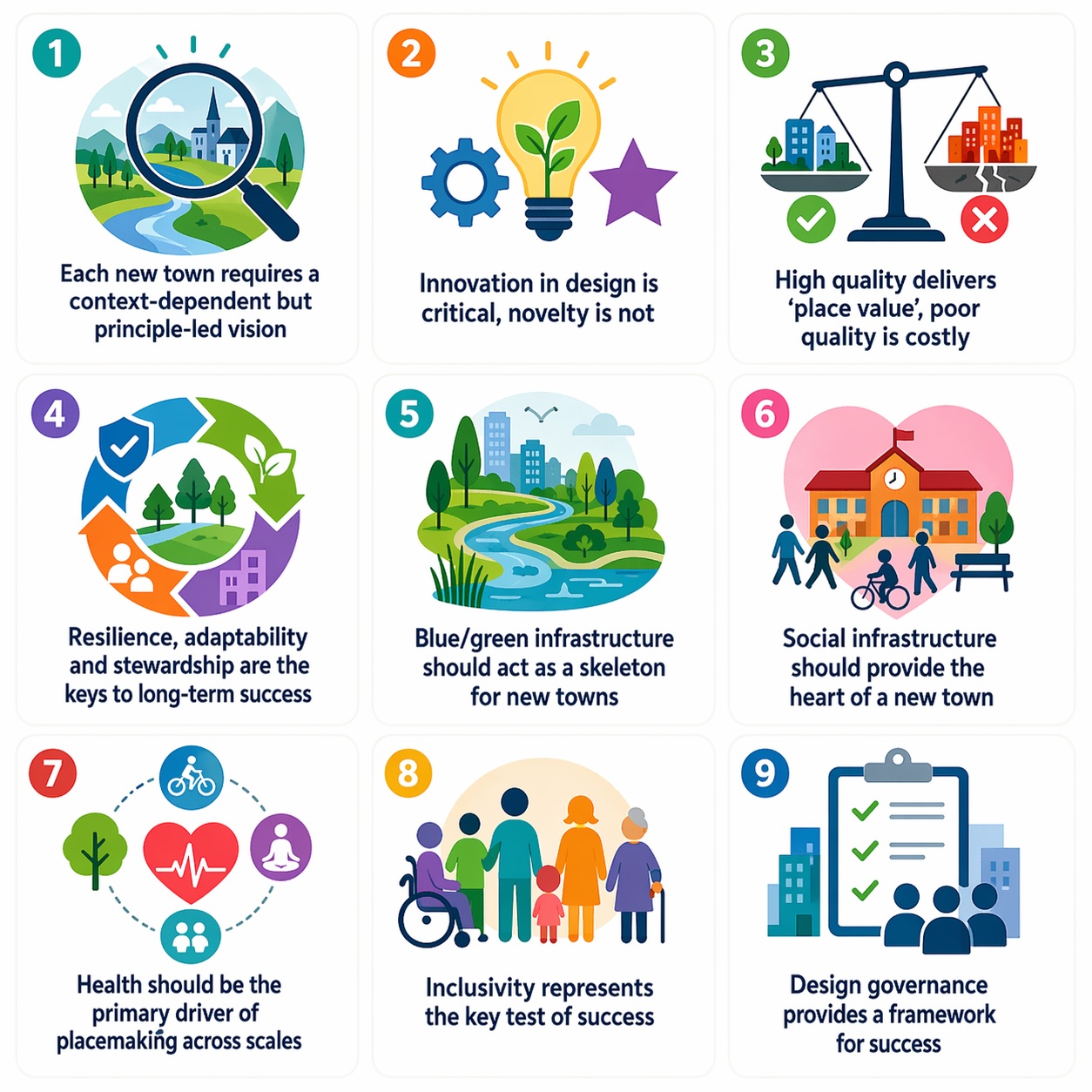
Across the vast body of evidence, a strong consensus emerged, distilled in my paper into nine key principles.
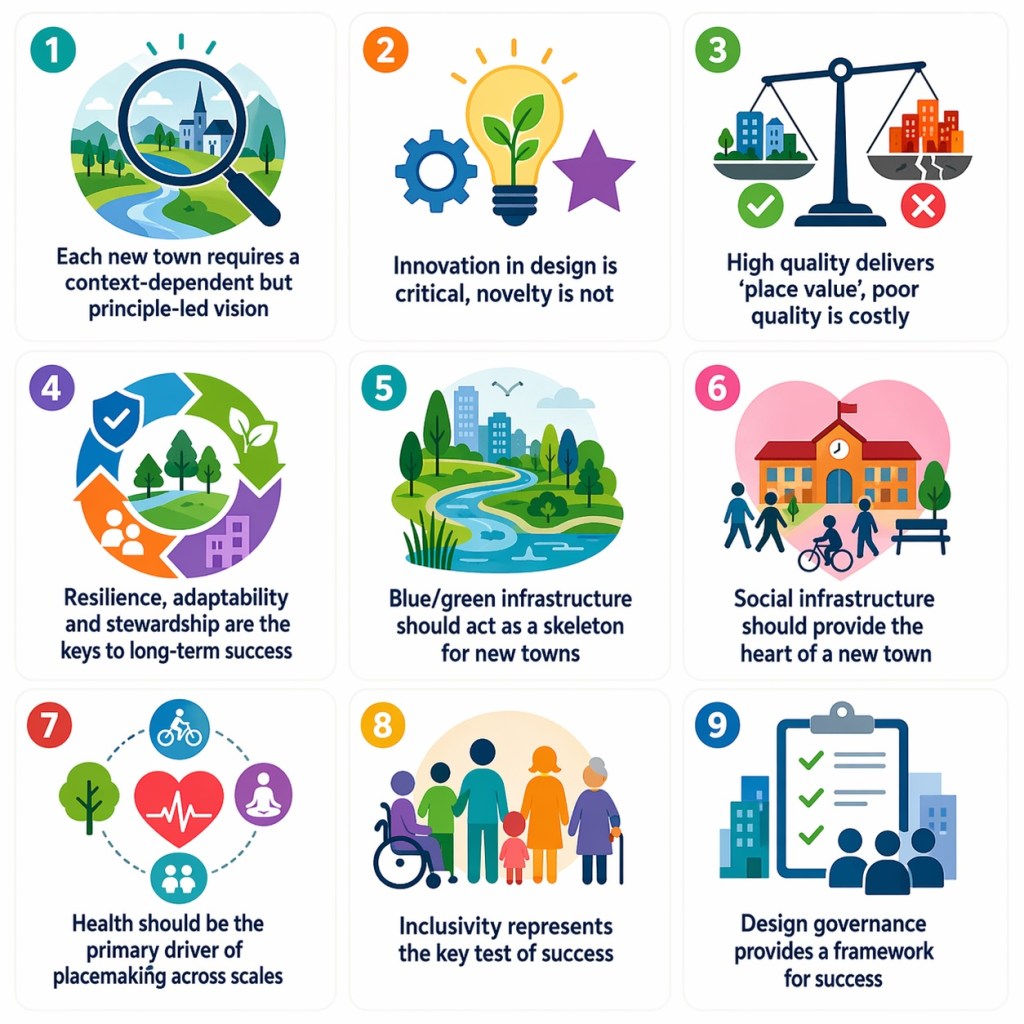
First, context matters. There is no one-size-fits-all model. Urban infill, edge-of-town extensions, and rural settlements each demand different approaches. What works in a dense city centre will not work on a greenfield site.
Second, innovation must be purposeful. New towns should act as laboratories for innovation – but not innovation for its own sake. The goal must be to solve real problems: climate change, loneliness, inequality, and housing quality.
Third, quality is an investment, not a cost. Poor design leads to long-term social, health, and environmental costs that far outweigh any short-term savings. High-quality placemaking, by contrast, generates lasting value.
Fourth, resilience must be built in from the start. New towns must be designed for a changing world – climate uncertainty, technological shifts, and evolving demographics.
Fifth, nature is not optional. Green and blue infrastructure should form the backbone of new developments, shaping their identity, health outcomes, and environmental performance.
Sixth, community infrastructure must come early. Schools, health services, parks, and social spaces cannot be afterthoughts. Without them, communities struggle to form.
Seventh, health should be designed into everyday life. Walkable neighbourhoods, access to green space, and opportunities for social interaction are not luxuries – they are essential determinants of wellbeing.
Eighth, inclusivity must be mainstreamed. New towns should work for everyone – across ages, abilities, genders and backgrounds – embedding accessibility and equity from the outset.
Ninth, design governance is critical. Without strong, long-term design governance structures – design leadership, competitions, frameworks, codes, design review, and engagement – good intentions will quickly erode under market pressures.
Together, these principles paint a picture of new towns as complex, living systems rather than static physical projects.
A civic project for the long term
Perhaps the most important insight from my analysis was that new towns must be treated as civic projects.
The post-war programme succeeded not just because of its design ideas, but because of its institutional framework. The state acted as a ‘patient investor’, coordinating land, infrastructure, and governance over decades. In contrast, many recent initiatives have struggled precisely because they lacked this long-term coherence.
The new generation of towns will require a similar mindset. They must be planned, delivered, and managed with a time horizon that extends far beyond electoral cycles. This means aligning planning, transport, health, education, and environmental policy – something that has often proved elusive in the UK.
The opportunity ahead
Britain’s housing crisis is real, and the pressure to build quickly is intense. But as this this blog makes clear, speed without strategy risks repeating the mistakes of the past. The opportunity now is not just to build more homes, but to build better places, places that foster belonging, resilience, and wellbeing.
If the lessons of history are heeded, the ‘new new towns’ could become exemplars of twenty-first-century living. If not, they risk becoming yet another chapter in the long, uneven story of British urban development.
The choice, ultimately, is not whether to build, but what kind of future the places we build will create.
Matthew Carmona
Professor of Planning & Urban Design
The Bartlett School of Planning, UCL

