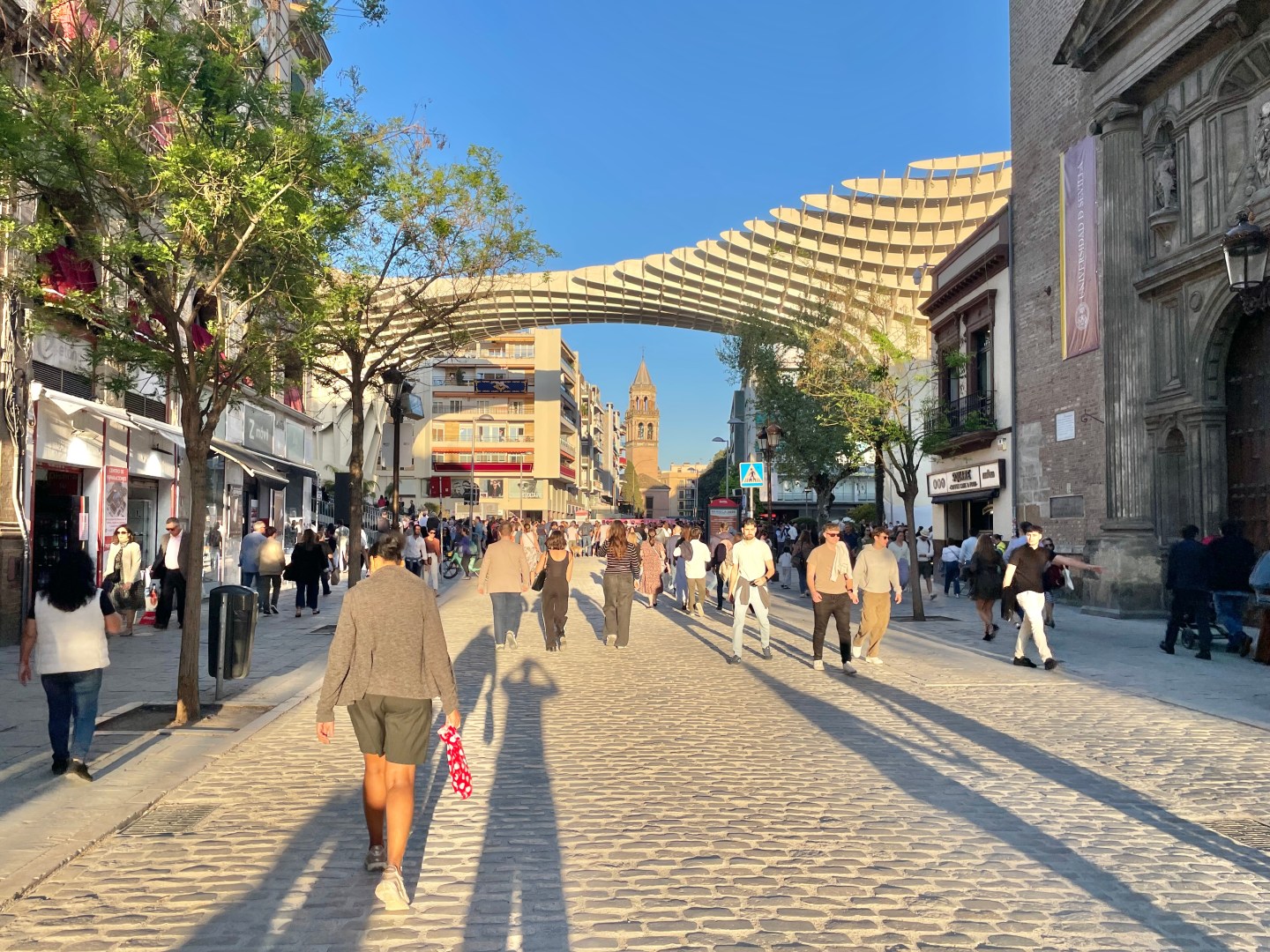
Every year, two old university friends and I set off on what we like to call a ‘study tour’ (my wife calls it a holiday). Our mission is simple: take the urban design temperature of a European destination and come back inspired. My last despatch followed a trip to Almere; this year, we headed south to Andalusia, tracing a route through, Cádiz, Seville Córdoba, and Granada
Public realm investment
Although my father’s family comes from the region, it had been years since I last visited. Returning now was a genuine delight, not just for the nostalgia, but for the transformation. Across these cities, the quality of the public realm has leapt forward.
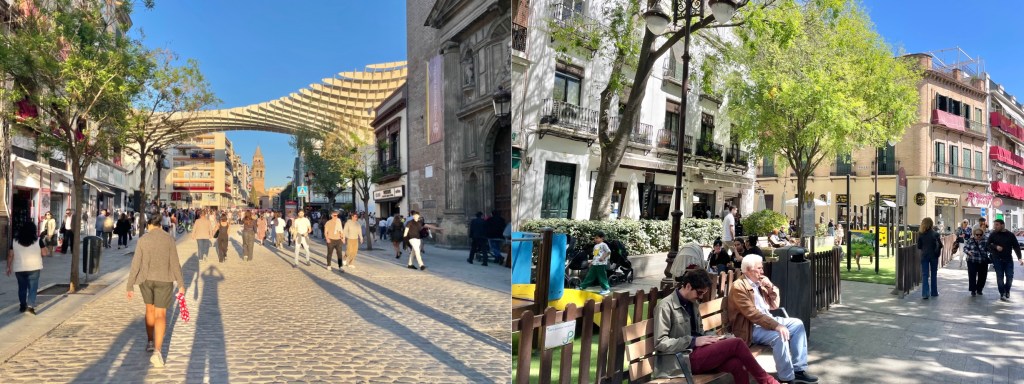
We focused mainly on historic centres, but what stood out was the sheer extent of pedestrianisation, and the consistency of its execution. Streets and squares were designed with restraint and confidence: natural materials, generous planting, and robust detailing that feels built to last.
The range was striking. Take Seville. There are the headline spaces such as Plaza de la Encarnación, animated by the sweeping structure of the Metropol Parasol. But equally compelling are the everyday places: Plaza de la Alfalfa, embedded in a local neighbourhood and filled with family life, or Calle San Luis, a gently animated street that stretches for over half a mile in uninterrupted granite setts, quietly connecting the centre to the old city walls. Even the nearby town of Carmona (just 30,000 residents) – from where us ‘Carmonas’ are thought to hail – offered street after street of carefully crafted, pedestrian-first spaces.
Why does this matter?
This is important because these spaces form the stage on which urban life unfolds. Across Andalusia, cities feel human, sociable, and genuinely liveable. And despite their popularity with tourists, they remain grounded in local life, accommodating everything from the mundane to the celebratory.
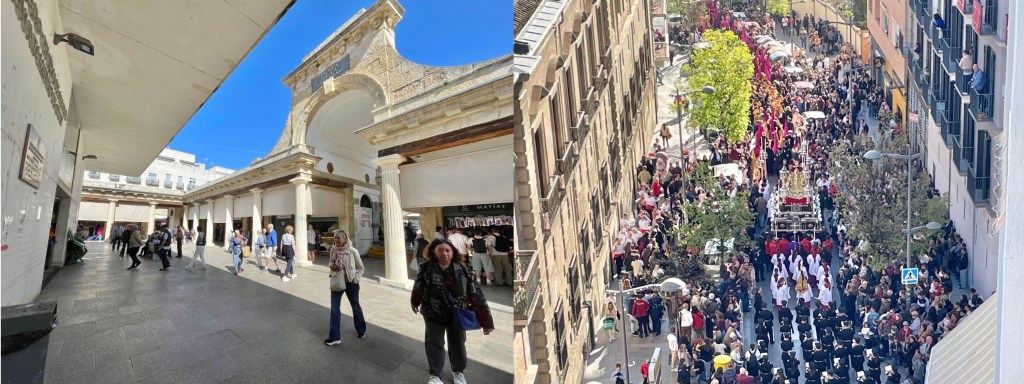
Cádiz’s Mercado Central de Abastos – Spain’s oldest covered market – is a case-in-point. Extensively refurbished some 15 or so years ago, by day we see a bustling food market. In the evening, its interior spaces have been designed to transform into a lively ring of bars and restaurants. Despite its historic pedigree, the design enables this shift, it doesn’t constrain it, supporting different dimensions of a vital public realm.
And then there are traditions. By chance, our visit coincided with the run-up to Easter – Semana Santa. In Andalusia, this is no small affair. Daily processions draw vast crowds, effectively closing city centres and turning them into shared civic stages. Brotherhoods (Cofradías), in their distinctive pointed hoods rooted in 15th-century traditions of penance, lead elaborate parades. Whatever your view of the symbolism, the atmosphere is unmistakable: intergenerational, participatory, and deeply embedded in place.
A foundation for growth
Spain’s investment in public space hasn’t happened by accident. In recent decades, the country has benefited significantly from European funding, particularly through the European Regional Development Fund and European Investment Bank loans. Andalusia has been a major recipient.
These funds have helped pedestrianise city centres, upgrade public spaces, and strengthen cultural and social infrastructure. The results are measurable. In a recent European urban mobility survey, Granada ranked highest among large cities for ‘space allocated to people’. 57.6% of its road network is pedestrian focused. For comparison, Naples sits at 10.9%, with London at 29.3%.
A productivity return on investment
This kind of investment is paying dividends. Spain is currently the fastest-growing major economy in the Eurozone, with GDP growth of 3.2% in 2024 – well ahead of its peers. Andalusia, in turn, is a significant contributor, outperforming the national average and accounting for around 13.5% of Spain’s total GDP.
Much of this growth is driven by a flourishing services sector, with advanced professional, scientific, and technical services, tourism and hospitality all expanding rapidly. While productivity still lags behind some more advanced economies, investment is rising at twice the pace of overall economic growth, and the gap is closing.
So, is there a link between public realm quality and productivity? It might sound like a stretch, but it isn’t. High-quality streets and public spaces are not just aesthetic upgrades; they are economic infrastructure. They attract talent, support local businesses, and create the conditions for innovation and wellbeing.
Evidence on this and other aspects of ‘place value’ is collected at www.place-value-wiki.net, but in brief:
- Attracting and retaining talent: In an era of hybrid and remote work, people choose cities as much for their quality of life as for their jobs. Parks, plazas, and walkable streets matter.
- Boosting footfall and local economies: People-friendly streets increase dwell time and spending, directly supporting local businesses.
- Improving wellbeing: Access to green, well-designed spaces reduces stress and improves productivity.
- Encouraging innovation: Public spaces act as ‘third places’ where informal interactions spark ideas – the so-called spillover effects that drive urban economies.
- Supporting health: Walkable environments promote physical activity, reducing long-term healthcare costs.
- Driving investment: High-quality environments increase property values and attract private capital.
I haven’t seen a dataset that offers a direct causal link between Andalusia’s public realm investment and its economic performance, but given the broader evidence, the alignment is hardly surprising. Places that invest in their public realm tend to reap broad, long-term rewards: social, economic, environmental, and cultural.
Investing in the UK?
A week after returning, I found myself – for the first time in years – walking the full length of London’s Oxford Street with my teenage daughter (an enthusiastic shopper!). The contrast was immediate and jarring.
How has the UK’s premier shopping street remained, for so long, a traffic corridor – one where, along much of its length, half the space is still given over to buses and taxis, while half a million pedestrians each day are left battling for space on the pavements? These modes clearly matter – around 160,000 people board or alight from buses daily – but the balance feels misplaced, especially when only a quarter that number travel all the way along the street.
So, the Mayor’s plans to pedestrianise much of Oxford Street are a no-brainer. At long last he has been able to find a way through the local opposition by setting up the Oxford Street Development Corporation to take control and do what should have been done decades ago. The potential benefits – for the street, for London, and for the wider UK economy – are enormous.
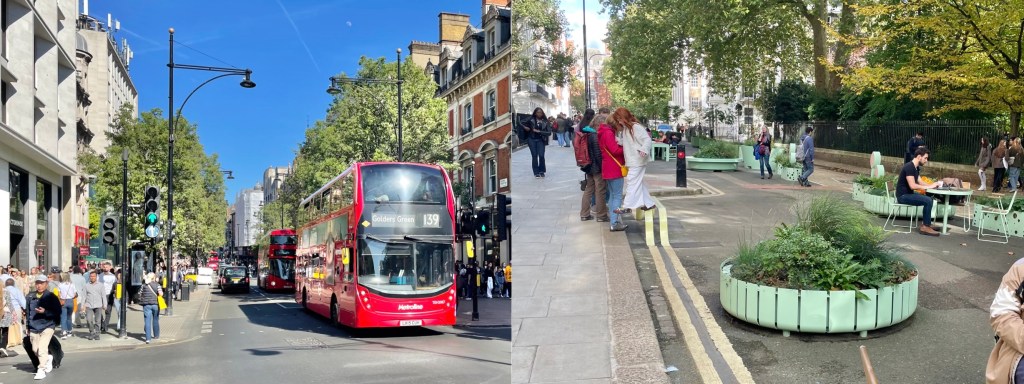
At a much smaller scale, but equally overdue, is the pedestrianisation of Gordon Street, led by UCL (my university), and Camden Council. This will be no less transformative, but obviously more local in its impact.
For many years the taxi lobby fought hard to keep this street open to cars given its proximity to Euston Station, but redevelopment at the station has finally changed all that and an eighteen-month trial has begun that is partially closing the street and will surely lead to a permanently pedestrianised environment. One the enabling works have been finished, I fully expect it to quickly fill with life as students and staff from the university departments around spill out into the space, just as they have done in a much smaller adjacent space on Gordon Square.
The hope is the likes of Oxford Street and Gordon Street will become catalysts for a much wider, sustained and ambitious investment in the public realm of London and far beyond. Spain has shown what’s possible with long-term commitment and funding. The UK has the opportunity to follow suit. It can’t come soon enough.
Matthew Carmona
Professor of Planning & Urban Design
The Bartlett School of Planning, UCL

