
25 years on
This year marks the 25th anniversary of the Urban Task Force report and the decade long sequence of policy, practice, and investment interventions that followed. At the heart of the initiative was an attempt to turn our suburban nation into an urban one while simultaneously solving the housing crisis. On the former, to a good degree, it succeeded, on the latter, it failed.
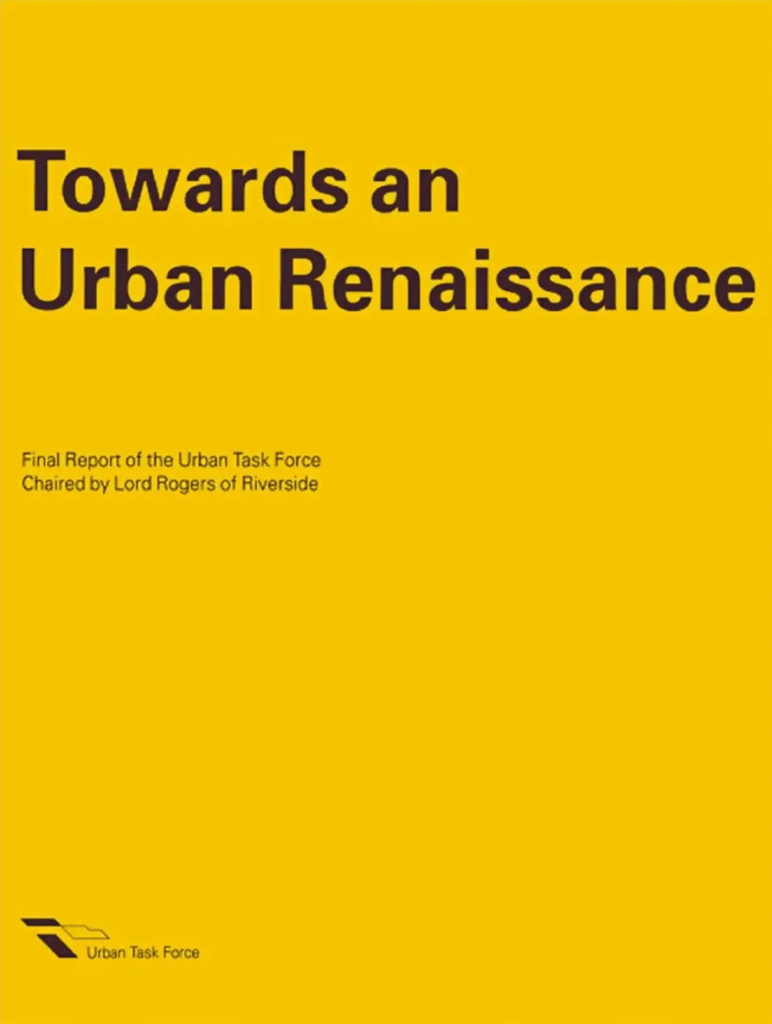
Its key success was to awaken us to the great value and potential of under-utilised urban land and to use place-based design strategies to encourage us to embrace urban living. On that front, across its 100+ recommendations the report espoused many of the essentials of the latest incarnation of those ideals, the 15 minute city. In doing so it encouraged a new wave of investment, both public and private, into our larger cities which, over time, also led to their densification; sometimes designed well and sometimes not.
Its failure was in Government timidity, then as now, to tackle the national housing delivery model that throughout the 1980s and 1990s had become ever more reliant on a few large national house builders whose rational interests as market players have rarely been served by maximising housing output. Instead, there is often a preference for drip feeding new housing on to the market to maintain sales values. And this too often goes hand in hand with avoiding building too much social housing and infrastructure, or housing environments of a better quality than absolutely required.
25 years on and looking at the prescriptions lined up in the famous yellow book, it is hard to see many that aren’t still relevant today and which an incoming government might like to revisit; albeit now we might expect to see a far greater emphasis on zero carbon, nature recovery, health and well-being, and affordability.
A new kid in town
On the design front, while the Urban Task Force did not recommend the setting up of CABE, that organisation emerged as part of the larger policy response and as a key entity charged with delivery of Urban Task Force recommendations, and notably with raising design quality ambitions across England. History tells us that the austerity years and everything that came after quickly swept all this away, and 15 years on we are reinventing the wheel: first through the Building Better Building Beautiful Commission report, and now the Office for Place.
The Office for Place is a new arms-length agency of Government with around 25 staff and a base in Stoke-on-Trent. It was formally launched with a fanfare in March, and I was fortunate enough to be invited to its inaugural conference, ‘Places at Pace’.
While the mood music around the Office for Place is clearly different to CABE – beauty, popular design, community engagement, digital technology, and a context of ongoing austerity – I could not help feeling a strong sense of déjà vu around the sorts of ‘tools’ that the new organisation plans to use. These include support to local government, publication of advice and best practice, training, research, and an initial focus on design coding that CABE also played a critical role in championing during its middle years.

The major absence is the omission of any design review function. CABE inherited its national design review role from the Royal Fine Arts Commission before it, but in many respects, it was always its Achilles heel, with many of the architects and developers who had fallen foul of its design judgements increasingly critical of this role and ultimately delighted at CABE’s demise. Curiously, there is now more design review, more widely spread than ever before, albeit not a national panel for which there seems little demand or potential any time soon.
My own research showed that CABE was a remarkably effective organisation in much (although not all) of what it did. Reflecting this, the Place Alliance and others made the case for re-establishing a national organisation to champion design quality in the immediate aftermath of the Building Better Building Beautiful Commission which, like the Urban Task Force before it, had not recommend setting up such an organisation. I am therefore delighted to see that after an extended period of gestation it is up and running.
My more recent research has shown how critical such advocacy and leadership of design quality can be at both national and local scales, notably for ensuring that a culture of design quality emerges and that this informs policy and place-based decision-making across the scales.
Wishing every success
Whether the Office for Place is as effective as CABE was, and I truly hope it will be, will depend on many factors, not least (one suspects) the attitude of the Labour Party. Notably it will depend on the place of design within their plans to (yet again) reform the planning system, something about which we have heard little.
Now that the Office for Place has been let off the leash of direct Government control, my hope is that they can capture a little of the spirit of renaissance that infected, in a positive sense, the CABE years. Ultimately the Office for Place needs to become the sort of challenging, proactive, and innovative driver of change that we so clearly need. It also, despite the predilections of some Ministers, needs to avoid being associated with a prescribed national style or any mechanism that might, rightly or wrongly, be seen to be imposing one.
There is now the potential to quickly gain momentum and after a decade and a half of hiatus, to become a strong national voice on design quality, helping to lead the national conversation (as CABE did) and drive change locally. In doing so, one hopes, it will feel able to speak truth to power – something that CABE struggled with – not least on the point of our national development model that for decades has been broken. Unfortunately, until we fix it (and that means much more than tinkering with the planning system) we will never get great design as a norm, never deliver enough new homes, and never complete the still much needed urban renaissance.
Matthew Carmona
Professor of Planning & Urban Design
The Bartlett School of Planning, UCL
 Matthew Carmona
4 comments
Comments are closed.